

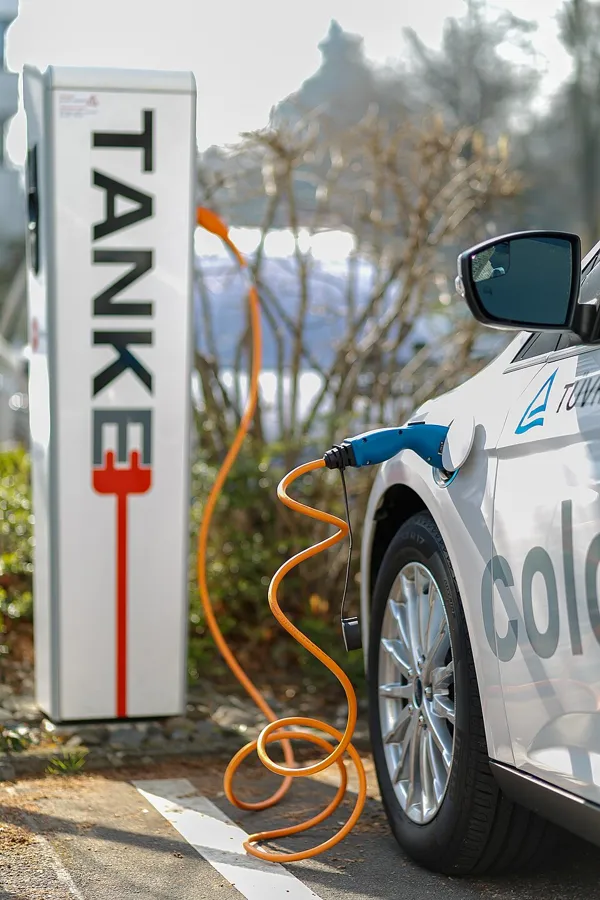
Range remains the first question asked before buying an electric car, well ahead of charging costs. It is also where the gap between the spec sheet and reality surprises buyers the most: a saloon rated at 500 km almost never shows 500 km on the dashboard. This article covers what the advertised figures are really worth, what melts the kilometres away, and how to pick a range that matches real journeys rather than worries.
Electric car range: the essentials
- New models advertise 300 to 700 km WLTP, around 450 km on average.
- In real conditions, subtract 20 to 30% from the advertised figure; more on a winter motorway.
- Speed and cold are the two most damaging factors.
- A real-world range of 250 to 300 km covers the daily use of the vast majority of drivers.
- The battery loses about 1.5 to 2% of capacity per year, warrantied 8 years or 160,000 km.
Electric car range: where the gap between advertised and real comes from
The range figures quoted by manufacturers come from the WLTP homologation cycle, a laboratory protocol shared across Europe. It makes model-to-model comparison possible, but it runs at an average speed of 46 km/h, without heating or air conditioning, on a driving profile far gentler than any real journey.
In normal use, subtract 20 to 30% from the WLTP figure. A compact rated at 420 km therefore covers 300 to 340 km in mixed driving, and noticeably less on a winter motorway. This gap is not a hidden flaw: it is systematic, well documented, and worth building into any needs assessment from day one.
| Advertised WLTP range | Real mixed driving | Winter motorway |
|---|---|---|
| 300 km | 210 to 240 km | 160 to 190 km |
| 450 km | 320 to 380 km | 250 to 290 km |
| 600 km | 430 to 500 km | 340 to 390 km |
The five factors that melt kilometres away
Several parameters directly affect an electric car’s real-world performance, and their impact adds up.
Speed comes first. Air resistance grows with the square of speed: going from 110 to 130 km/h pushes consumption up by about 25%. That is why an electric car that feels tireless in town can disappoint on the motorway.
Cold comes next. Below 5°C, battery chemistry loses efficiency and the heater draws directly from the pack: winter routinely removes 20 to 30% of range. Models fitted with a heat pump limit the damage considerably, a spec worth checking before buying.
Then come terrain (a long climb consumes heavily, even if the descent regenerates part of it), payload and tyre condition. A tyre under-inflated by 0.5 bar is enough to raise consumption measurably, electric or not.
Which models go the distance
The 2026 market splits into three families. City cars (Renault 5 E-Tech, Citroën ë-C3, Fiat 500e) offer 250 to 400 km WLTP, ample for urban and suburban use. Compacts and family saloons (Tesla Model 3, Renault Scénic E-Tech, Peugeot e-3008) sit between 450 and 700 km depending on the battery. At the top end, a few grand tourers climb to 700 km WLTP and beyond, at prices that still reserve them for wealthy buyers. The best ranges on the market cluster in that category: yearly rankings consistently place large saloons with 90 kWh-plus batteries at the top, a type of vehicle built for the motorway more than the city.
To compare two close rivals, the duel between the BYD Seal and the Tesla Model 3 shows the right way to read the numbers: beyond the WLTP figure, real consumption per 100 km and charging speed make the daily difference. The same reasoning applies to company cars, where range defines professional usability.
Charging, the other half of the equation
Reasoning in kilometres of range alone misses half the subject: the density of the charging network matters as much as battery size. France now exceeds 150,000 public charging points, and almost every motorway service area offers fast charging. Completing a Paris-Marseille run in an electric car is no longer an expedition: a 20-to-25-minute stop every two and a half hours is enough, roughly the rest rhythm recommended to any driver.
At home, installing a 7.4 kW wallbox or a reinforced socket transforms the experience: the car plugs in at night like a phone and leaves every morning with a full tank of energy for a fraction of the price of petrol. In France, grants exist for home equipment, including a 500-euro tax credit for a smart charger and reduced VAT on installation. Carmakers and charging networks also offer route-planning services that build charging stops in automatically, often directly in the car’s navigation. The real learning curve is not technical: it is mostly about changing reflexes, charging where the car sleeps rather than hunting for a station when the gauge drops.
Battery: how much wear over the kilometres?
Battery wear feeds plenty of worry, for an ultimately measured impact. A lithium-ion pack loses on average 1.5 to 2% of capacity per year. To put a number on it: a car advertising 450 km WLTP when new will keep roughly 380 to 400 after eight years, a level of performance that still covers daily use very comfortably.
Almost all manufacturers warranty the battery for 8 years or 160,000 km, with a 70% minimum capacity floor. Chemistry type matters too: LFP batteries, increasingly common on entry-level models, tolerate daily charging to 100% where NMC chemistries prefer stopping at 80% day to day. A point worth checking in the manual, since it determines the range actually available each morning.
How much range do you actually need?
The average French driver covers less than 50 km a day. With a real-world range of 250 to 300 km, a week of commuting fits on a single charge, done at home or at the office. Buying 700 km of range for that profile means paying for a big battery that only earns its keep a few weekends a year.
The question changes for high-mileage drivers and motorway regulars. There, two figures matter more than headline range: consumption at 130 km/h and the 10-to-80% charging time on a fast charger. A car that recovers 300 km in 20 minutes makes long trips calmer than a rival with a bigger battery but slower charging.
Six habits that add kilometres back
A few simple habits optimise range without sacrificing any comfort:
- Anticipate rather than brake: smooth driving maximises regeneration on lift-off.
- Slow down on the motorway: driving at 120 rather than 130 km/h extends range very noticeably.
- Pre-heat the car while charging: the cabin warms up on grid power, not on the battery.
- Use heated seats rather than cabin heating; they draw far less power.
- Check tyre pressure monthly, and aim for the higher recommended value.
- Remove roof boxes and bike racks when unused: aerodynamics weigh heavily at cruising speed.
Electric mobility goes beyond the car, too: for short urban trips, an electric scooter or electric bike complements an equipped household well, and the electric motorcycle market is progressing fast.
Buying used: check before you sign
On the used market, the range shown in the listing is the original WLTP figure, not what the battery delivers after years of service. The right reflex is to ask for the battery state-of-health certificate (SoH), which most dealers and workshops can produce. A 90% SoH on a car rated at 400 km means roughly 360 km WLTP remaining, to be converted into real range with the usual 20 to 30% discount.
The charging history deserves a look too: a car charged daily on high-power DC ages slightly faster than one plugged in overnight at home. Nothing disqualifying, but a negotiation argument. Finally, the average consumption in kWh/100 km shown on the trip computer says more than a long test drive: below 16 kWh/100 km in mixed use, the car is frugal; above 20, range will melt fast on the motorway.
And in five years?
Batteries gain roughly 5 to 8% energy density per year, and the first solid-state cells announced for the end of the decade promise a further jump. In other words, range anxiety increasingly belongs to the past: the real question for a 2026 buyer is no longer “how many kilometres”, but “what charging, where, and at what price”.
Frequently asked questions
What is the average range of an electric car in 2026?
New models advertise between 300 and 700 km of WLTP range, with an average around 450 km. In real conditions, expect 20 to 30% less: a car rated at 450 km actually covers 320 to 380 km depending on season, speed and terrain.
Why is real range lower than the advertised figure?
The WLTP homologation cycle runs in a laboratory at an average speed of 46 km/h, with no heating or air conditioning. At 130 km/h on the motorway, consumption rises sharply, and cold weather can remove another 20 to 30% of range. Both effects combined explain the gap drivers experience.
Does battery range degrade over time?
Yes, but more slowly than often feared. A lithium-ion battery typically loses 1.5 to 2% of capacity per year. Most manufacturers warranty the battery for 8 years or 160,000 km, with a guaranteed floor of 70% remaining capacity.
How much range do you actually need for daily use?
The average French driver covers less than 50 km a day. A real-world range of 250 to 300 km therefore covers a full week of commuting on a single charge, at home or at work. Long range only really matters for regular motorway trips.
Does driving fast reduce range that much?
It is the single most damaging factor. Going from 110 to 130 km/h increases consumption by roughly 25%: on a long trip, slowing down by 10 km/h can add back several dozen kilometres of range, often more than a detour to a fast charger costs.