

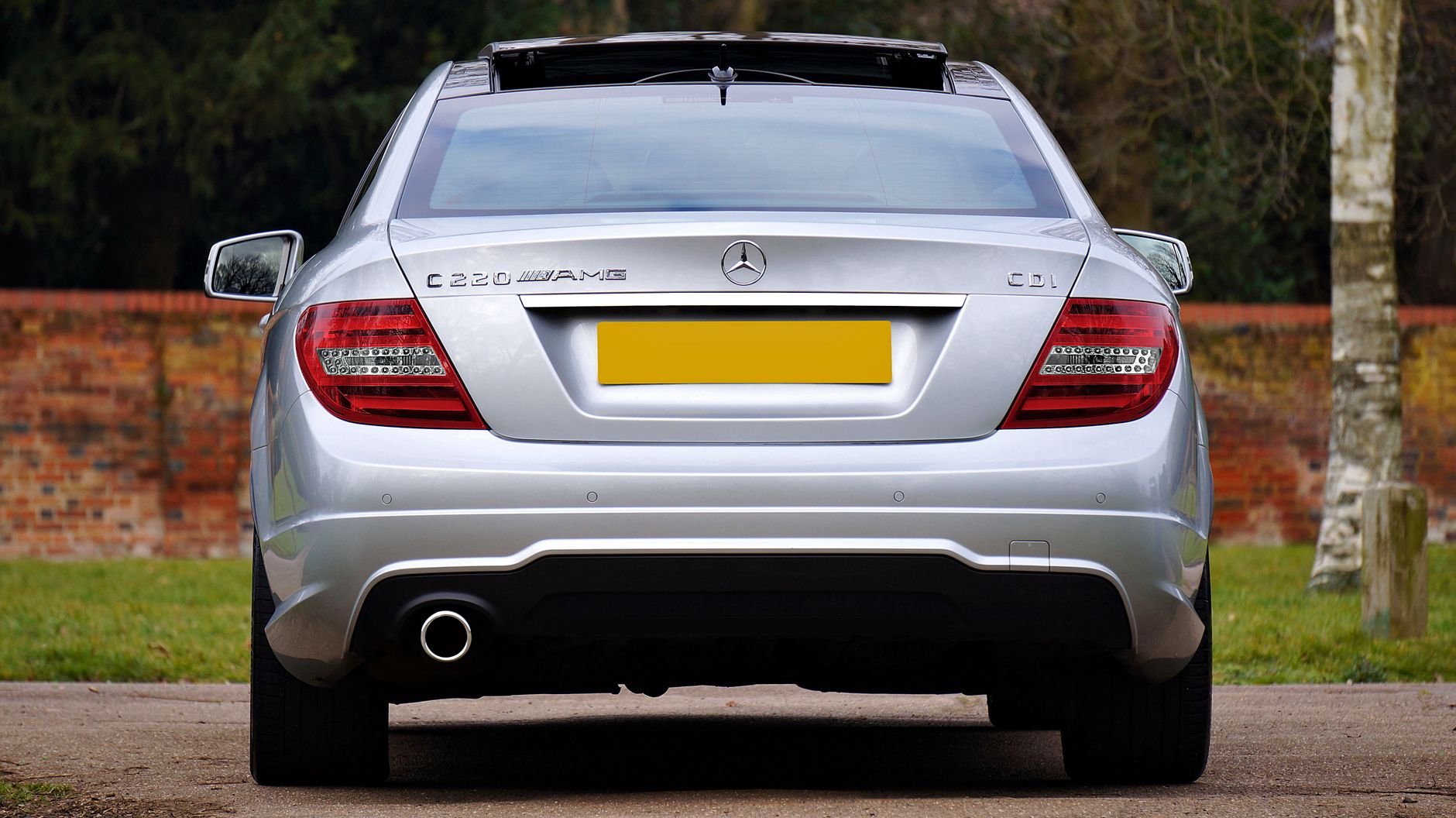
The French ecological penalty, also called the CO2 malus or eco tax, applies when a passenger car deemed too polluting is first registered in France. A second charge, the weight-based malus, has applied since 2022 for the heaviest vehicles. This guide details the 2026 scale, which vehicles are covered, the available exemptions and reductions, and the specific rules for used cars.
French ecological penalty: the essentials
- The 2026 CO2 malus starts at 108 g/km of CO2 (50 euros) and climbs to 80,000 euros above 191 g/km.
- The weight-based malus kicks in from 1,500 kg, with a marginal rate of 10 to 30 euros per kg depending on the bracket.
- Full exemption for fully electric and hydrogen vehicles, and for holders of a CMI disability card.
- The two combined penalties can never exceed the CO2 penalty cap, set at 80,000 euros in 2026.
- No penalty is due for vehicles first registered more than 10 years ago.
The 2026 CO2 malus scale
The CO2 penalty is calculated from carbon dioxide emissions measured under the WLTP cycle, expressed in grams per kilometer. The scale is revised upward every year: in 2026, the trigger threshold drops to 108 g/km, down from 118 g/km in 2024, and the cap rises further still. The amounts below give the order of magnitude applicable in 2026; always check the official scale at the time of purchase.
| CO2 emissions (WLTP) | 2026 penalty amount |
|---|---|
| 107 g/km or less | 0 euros |
| 108 g/km | 50 euros |
| 120 g/km | 310 euros |
| 130 g/km | 983 euros |
| 140 g/km | 2,205 euros |
| 150 g/km | 4,279 euros |
| 160 g/km | 8,770 euros |
| 170 g/km | 22,380 euros |
| 180 g/km | 45,990 euros |
| 191 g/km | 79,911 euros |
| More than 191 g/km | 80,000 euros (cap) |
Between the brackets shown here, the amount increases gram by gram on a much finer grid than this summary table: a single extra gram of CO2 can shift the bill by several hundred euros once past 160 g/km. According to a study cited by the French automotive press, around 72% of new vehicles sold in France would be affected by some level of penalty in 2026, even a small one, making it a factor worth checking systematically before buying.
What is the French ecological penalty and which vehicles are covered?
The ecological penalty is an additional tax on the cost of vehicle registration, introduced by the finance law of 25 December 2007 and tightened almost every year since it took effect on 1 January 2008. Originally designed as the counterpart to the ecological bonus, it targeted a small number of very high-emission vehicles; trigger thresholds have been lowered year after year, so that a growing share of the new car market is now affected, even for a modest amount.
It applies to category M1 vehicles (passenger cars) upon their first registration in France, whether new or imported from abroad. This notably covers standard passenger vehicles, but also certain pick-up trucks with 5 or more seats, which are treated as passenger cars for the purposes of this tax.
Light commercial vans (CTTE category) and vehicles adapted for disabled passenger transport (VASP) are in principle exempt from the eco tax upon first registration. There is, however, one exception worth knowing: since 1 July 2020, a utility or company vehicle converted into a passenger car becomes liable for the penalty at the time of that conversion, not only at its original first registration. The technical eCoC scheme, which links back to the WLTP CO2 emissions of the base vehicle, is then used as the reference to calculate the amount due upon this conversion.
Vehicles running on E85 superethanol benefit from special treatment detailed further below, as do hybrid and electric vehicles, whose battery weight directly affects the second part of the tax: the weight-based malus.
The weight-based malus: a second charge
Since 2022, a weight-based malus has applied on top of the CO2 penalty for passenger vehicles whose unladen running weight exceeds 1,500 kg, as shown in box G of the registration certificate. It is paid at the same time as the registration certificate, upon first registration.
The calculation applies a marginal rate per weight bracket, which rises as the vehicle gets heavier.
| Unladen running weight | Marginal rate per kg |
|---|---|
| Up to 1,499 kg | 0 euros |
| From 1,500 to 1,699 kg | 10 euros |
| From 1,700 to 1,799 kg | 15 euros |
| From 1,800 to 1,899 kg | 20 euros |
| From 1,900 to 1,999 kg | 25 euros |
| From 2,000 kg | 30 euros |
Example calculation for a 1,650 kg vehicle in 2026: (1,650 minus 1,499) multiplied by 10 euros, or around 1,510 euros of weight-based malus.
Full exemption for electric and hydrogen vehicles
Vehicles running exclusively on electricity or hydrogen remain fully exempt from the weight-based malus in 2026, regardless of their actual mass. This exemption was confirmed by the 2026 finance law, with no transitional mechanism or partial allowance, unlike what had initially been considered in early budget drafts. It effectively neutralizes the structural extra weight caused by batteries, particularly for electric SUVs.
Weight reduction for hybrid vehicles
Non-plug-in hybrids and plug-in hybrids benefit from a flat reduction applied to the weight used for the calculation, which varies according to their electric range:
- Non-plug-in hybrid vehicle: weight reduced by 100 kg.
- Plug-in hybrid with an electric range above 50 km: weight reduced by 200 kg, capped at 15% of total weight.
- Plug-in hybrid with an electric range below 50 km: weight reduced by 100 kg.
In every case, the combined CO2 and weight-based penalties for a single vehicle can never exceed the CO2 penalty cap, set at 80,000 euros in 2026.
Ecological bonus versus ecological penalty: what is the difference?
The ecological bonus and the ecological penalty are, in theory, two sides of the same scheme: one financially rewards the purchase of a low-emission vehicle, the other penalizes the purchase of a high-emission one. In practice, the two mechanisms have followed very different paths in recent years.
The penalty now covers an ever wider range of vehicles as its trigger threshold keeps dropping, while the ecological bonus has instead narrowed: since 2024 it has been reserved for individuals under income conditions buying a new electric vehicle, and legal entities (businesses, associations, local authorities) have been excluded from it since 2 December 2024, along with the conversion bonus. A single vehicle can therefore never combine a bonus and a penalty: a new electric vehicle may qualify an eligible individual for the bonus, while a high-emission combustion model remains subject to the penalty, with no equivalent scheme available to offset its cost.
Who is exempt from the French ecological penalty?
Three situations grant a full exemption from the penalty, whether the CO2 or the weight-based component:
- Wheelchair-accessible passenger vehicles.
- Vehicles whose owner, or long-term lessee for at least 2 years, holds a mobility inclusion card (CMI) with a disability rating, a military disability card, or whose dependent child holds one of these cards.
- Vehicles running exclusively on electricity or hydrogen, for both parts of the penalty.
A penalty paid in error in one of these situations can be the subject of a refund request to the tax authorities, supported by the relevant documentation.
Partial reductions: E85 superethanol and large families
Beyond full exemptions, two situations grant a partial reduction of the CO2 penalty without cancelling it entirely.
A vehicle running on E85 superethanol and emitting no more than 250 g of CO2 per kilometer benefits from a 40% reduction on the emission rate used to calculate the penalty, or a 2-horsepower reduction where the applicable scale is based on administrative power. In practice, a vehicle rated at 200 g/km will be taxed as if it emitted 120. This reduction is normally applied directly in the calculation, and otherwise can be the subject of a partial refund request.
Households with effective and permanent care of at least three children also benefit from a reduction, for a passenger vehicle with 5 or more seats, purchased or leased long-term, limited to one vehicle per household every 2 years. This includes children attached to the household for family benefit purposes as well as fostered children.
The ecological penalty on a used car
The rules differ significantly depending on whether a used car has already been registered in France or is imported from abroad.
For a vehicle already registered in France, no new penalty is in principle due on a change of ownership: the penalty was already paid by the first buyer at first registration. Since 1 January 2025, an exception exists, however, for vehicles that initially benefited from an exemption and later lose that status, for example following a technical modification that takes the vehicle out of its original category.
The 10% yearly reduction
For an imported used vehicle, whether coming from abroad or registered in France for the first time after being used elsewhere, the penalty calculation is based on the scale in force on its first registration date, with a 10% reduction for each year elapsed since that date. A new calculation method, introduced by the 2025 finance law and applicable since 1 March 2025, sets out a flat reduction coefficient valid until 31 December 2026.
No penalty for vehicles registered before 2015
Beyond 10 years of age, meaning for any vehicle first registered more than 10 years ago, no penalty is due, regardless of its CO2 emission level. This threshold applies equally to vehicles bought in France and to imported ones.
How the penalty is calculated: the WLTP standard
Since 2021, the CO2 penalty calculation has relied on the WLTP standard (Worldwide Harmonized Light Vehicles Test Procedure), which replaced the older European NEDC cycle. This test protocol, closer to real driving conditions, factors in elements such as the weight of options fitted to the vehicle, which explains why two units of the same model can show slightly different CO2 figures depending on their equipment level.
For a vehicle that was first registered before the switch to WLTP, the scale and standard in force on its first registration date apply in the event of a later conversion, along with the reduction described above. Drivers comparing several models before a purchase also have an interest in checking the gap between advertised and real-world electric car range, a separate topic from the penalty but just as decisive in the final choice.
The ecological penalty and businesses: fleets, the scrapped bonus, and remaining support
The ecological penalty applies to businesses under exactly the same rules as to individuals, with no special regime tied to professional status. For a vehicle fleet, it represents an acquisition cost to factor in as early as the model selection stage, alongside depreciation or the company car tax, a separate annual charge that comes on top of the penalty paid once at purchase.
Since 2 December 2024, legal entities can no longer benefit from the ecological bonus or the conversion bonus when buying a new vehicle. In exchange, since 30 December 2024 they can draw on Energy Savings Certificates (CEE) for the purchase or long-term lease of an electric vehicle, as well as certain regional schemes depending on the area. As a point of reference, CEE grants paid out within one major manufacturer’s network at the end of 2024 ranged from 320 to 535 euros per light electric vehicle, depending on the size of the beneficiary business’s or local authority’s fleet.
For a fleet that renews its vehicles regularly, factoring the ecological penalty into the car policy from the outset helps steer choices toward models that limit the double hit of the CO2 and weight-based penalties. Choosing an electric car lease also lets a business, just as an individual, avoid both penalties altogether, since electric vehicles are fully exempt from them, unlike an equivalent combustion or hybrid model.
How and when to pay the French ecological penalty
The ecological penalty is paid in a single instalment, at the time of the vehicle’s first registration, together with the cost of the registration certificate. For a new purchase from a dealer, the dealer usually includes the penalty amount directly in the total price billed before handling the registration.
In the case of a private sale of an imported vehicle, or any situation where the penalty was not collected automatically, it is up to the buyer to complete the process and pay directly on the website of the National Secure Titles Agency (ANTS), when applying for the registration certificate. A penalty miscalculated or wrongly collected, for example in an exemption situation that was not accounted for, can be the subject of a refund request after the fact to the tax authorities, upon presentation of the supporting documents for the vehicle and, where relevant, for the holder’s situation.
Before settling on one of several models with similar emissions, it is also worth comparing their overall budget, for example through the comparison of affordable electric cars, which escape this penalty altogether anyway. For a model still undecided between several engine options, the CO2 penalty amount shown on the manufacturer’s technical sheet, even before visiting the dealer, remains the fastest way to rule out the most heavily penalized versions from the start.
Frequently asked questions
What is the 2026 CO2 malus scale in France?
The penalty starts at 50 euros for a vehicle emitting 108 g of CO2 per kilometer and rises sharply by bracket up to 80,000 euros above 191 g/km. Below 108 g/km, no CO2 penalty is due.
What is the maximum amount of the French ecological penalty?
The CO2 penalty cap is set at 80,000 euros in 2026 and is due to rise to 90,000 euros in 2027. This cap also applies to the combined CO2 and weight penalties for the same vehicle: their sum can never exceed it.
Does the ecological penalty apply to used cars?
In principle, no, for a used car already registered in France, except in the specific case of a utility vehicle converted into a passenger car. An imported used car remains subject to the scale in force on its first registration date, with a 10% reduction per year elapsed, and no penalty is due beyond 10 years of age.
How can you avoid paying the French ecological penalty?
Fully electric or hydrogen vehicles are entirely exempt, as are wheelchair-accessible vehicles or households holding a CMI disability card. A vehicle running on E85 superethanol emitting up to 250 g/km benefits from a 40% reduction on the CO2 rate used for the calculation.
Who has to pay the French ecological penalty?
The penalty is owed by the buyer of a new passenger vehicle upon its first registration in France, whether an individual or a business. It is usually included by the dealer in the total registration cost, or paid directly on the ANTS website in the case of a private sale of an imported vehicle.
Does the ecological penalty apply on top of the weight-based malus?
Yes, the two charges are cumulative and add up for the heaviest, most polluting passenger vehicles. Fully electric and hydrogen vehicles, however, are entirely exempt from the weight-based malus regardless of their mass.