

In brief
- Free track riding is a contractual definition with five cumulative conditions. A single missing one, timing for instance, takes the session out of scope.
- Several road policies keep third-party liability in force during free track riding. The AMV motorcycle general conditions state it explicitly. Damage cover does not automatically follow.
- Competition is covered by no road policy. It requires a federation licence or a motorsport contract.
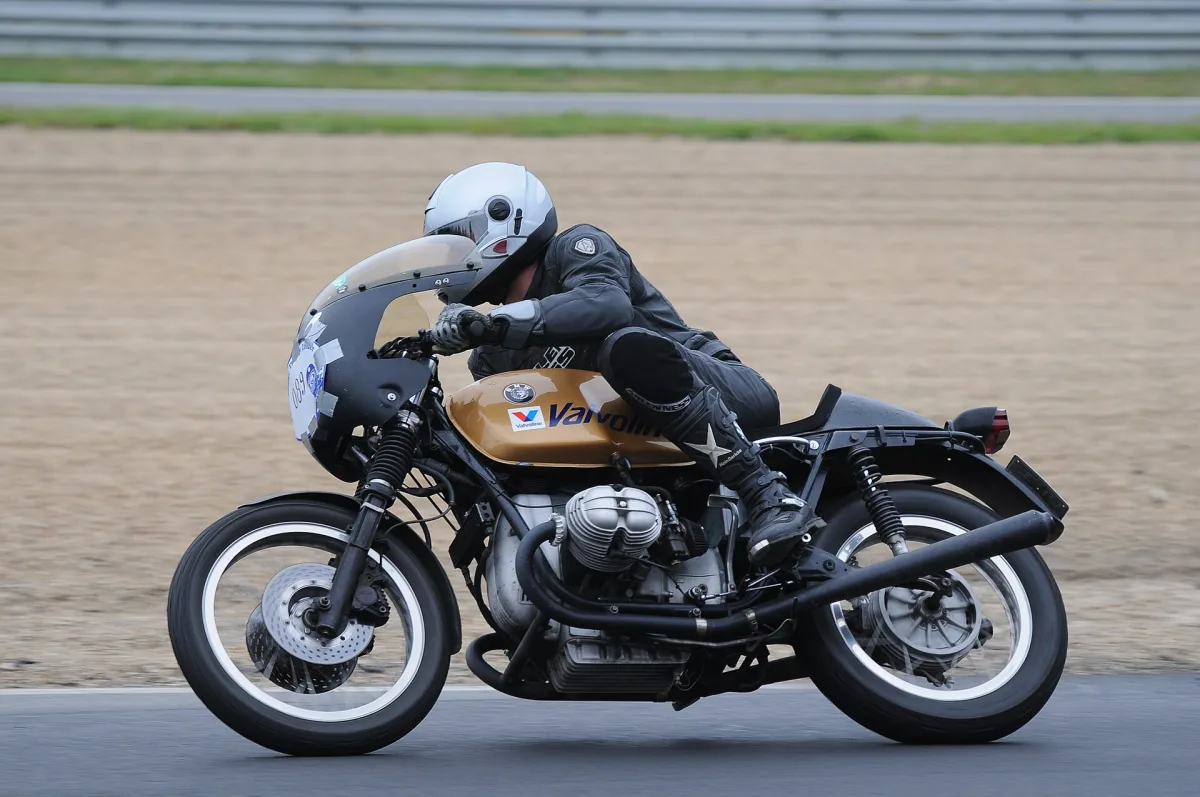
A track session is the moment a motorcycle policy shows what it is worth. Most riders turn up to a track day assuming they are insured as they are on the road, which is true on one item and false on every other. The dividing line is not the circuit, the speed or the machine, but the legal setting of the session.
What the policy calls a circuit
The word does not carry its everyday meaning. The AMV motorcycle general conditions define a circuit as a closed route that can be covered several times without leaving it, using only roads closed to public traffic, permanently or temporarily, with a layout marked out by any means and a surface of any nature.
Two practical consequences follow. A mountain road closed for the occasion becomes a circuit in contractual terms, with no pit lane or kerbs required. And a session on a mixed layout, tarmac then dirt, remains a single circuit.
Free track riding and its five cumulative conditions
This is the notion that decides everything. The same general conditions define free track riding as a leisure sporting practice meeting five conditions.
| Contractual condition | What takes the session out of scope |
|---|---|
| Occasional use | Regular practice, closer to training |
| On a circuit | Any use outside the closed layout |
| In a personal capacity | Riding on behalf of a third party, a school or a team |
| Outside any competition, ranking or timing | A simple official session timing |
| Outside any event subject to prior authorisation from public authorities | A gathering declared to the authorities |
All five are cumulative. The third and fourth catch riders out most often, because an organised track day slips into timed sessions without the rider seeing a change of nature.
What stays covered, and what does not
On the heaviest item, third-party liability, the AMV motorcycle general conditions state that third-party liability cover applies in the event of free track riding. A rider who injures a third party or damages property remains covered in that specific setting.
The rest is far less clear, and that is where the real financial exposure sits.
- Comprehensive damage cover is generally not extended to circuits explicitly. Yet machine damage is the costliest item in a track crash, fairings and exhaust first.
- Equipment cover follows the same logic, the policy does not mention it for circuit use.
- Personal rider cover, where it exists, is drafted for road traffic accidents, which does not mechanically extend to a fall on a closed layout.
The reflex that avoids bad surprises fits in one sentence: ask your insurer, in writing and before the session, what applies beyond third-party liability.
Beyond free track riding, three distinct regimes
| Situation | Road policy | What you need on top |
|---|---|---|
| Free track riding, road-legal bike | Third-party liability maintained | Nothing mandatory, day cover for machine damage remains useful |
| Competition, ranking, timing | No cover | Sporting federation licence, or motorsport policy |
| Non-homologated bike, pure track bike | No cover | Dedicated policy, the vehicle is not registered |
The second line is the one that surprises. A motorcycle policy, even comprehensive, stops producing effects the moment the session becomes competitive. This is not small print, it is the founding principle of a road policy.
What to check before a track day
- The setting announced by the organiser, free riding or timed sessions. The answer is in the day’s regulations.
- An explicit circuit clause in your own general conditions, not only in the sales brochure.
- The homologation of the machine and its conformity with the registration document, derestricting alone voids cover.
- The day cover offered by the organiser, which addresses exactly what a road policy leaves out, damage to your own bike.
- The level of personal rider cover, the only line that pays for bodily injury when nobody else is involved.
What insurer practice shows
Policies on the market agree on two points and diverge on the third. They all exclude competition. Almost all accept free track riding for third-party liability. They differ on extending damage cover to circuits, which is a specific option where it exists at all.
That third point is the one worth pressing your insurer on, because it decides whether a crash at 120 kph costs an excess or the price of a motorcycle.